· 6 min read
The Negative as Score: Adams, Print Values, and the Logic of Dodging and Burning
How Ansel Adams treated the negative as a fixed score and the print as performance, holding back and burning in to realize a visualized tonal scale.
Written in by Simon Lehmann Editor
A negative records a fixed range of densities, but no print is obliged to reproduce that range as it stands. The printing paper is the second half of the tonal system: it decides how a given span of negative density is mapped onto the scale from paper-base white to maximum black. On a glossy fibre-base paper that scale runs from roughly 0.04 logD at the base white to a maximum black, or Dmax, of around 2.1 logD; on resin-coated paper the achievable black is a little lower, and on a matt surface lower still, which is the concrete reason surface choice changes the usable range before you have touched a filter. Choosing the wrong relationship leaves a print either flat and grey or harsh and broken, regardless of how the negative was exposed. Contrast grade is the name for that relationship, and understanding it is what makes a negative printable rather than merely developed.
Every photographic paper has a characteristic curve relating exposure to resulting density. The horizontal width of the useful portion of that curve is the paper’s exposure range: the difference in log exposure between the value that just lifts off paper-base white and the value that just reaches full black. A short exposure range means a small change in negative density swings the print from white to black, which is high contrast. A long exposure range spreads the same tonal journey across a wider span of densities, which is low contrast.
This property is standardised. ISO 6846:1992 defines how the ISO speed and ISO range of black-and-white papers are determined from measured sensitometric curves. The ISO Range figure, denoted R, is the log exposure range multiplied by one hundred, so higher R values correspond to softer, lower-contrast papers. The numbers are published per filter. Current Multigrade RC Deluxe runs R160 at filter 00, R130 at 0, R110 at 1, R90 at 2 and with no filter at all, R70 at 3, R60 at 4 and R50 at 5. The discontinued Multigrade IV RC Deluxe ran wider, from R180 at 00 to R40 at 5, and Multigrade RC Warmtone wider still, R190 down to R50, which is why an old filter set or an old box of paper does not behave like the current ones.
The figure is directly actionable at the easel. Take a negative whose effective density range measures 1.32 log exposure units: multiply by 100 to get 132, choose the nearest published ISO Range figure, which is 130, and print through the matching filter. On current Multigrade RC Deluxe R130 is filter grade 0. The same arithmetic ties straight back to exposure on the negative. A full Zone I to Zone IX print needs roughly the paper’s whole exposure range, so a flat negative measuring about 0.7 logD wants a hard grade 4 to 5 to stretch it out, while a contrasty negative around 1.5 logD wants a soft grade 00 to 0 to rein it in. The negative’s density range and the paper’s exposure range are two halves of the same equation, and grading is the act of pairing them.
Graded papers carry a single, fixed exposure range built into the emulsion at manufacture, numbered 0 to 5 with grade 0 the softest, grade 5 the hardest, and grade 2 the normal response suited to a correctly exposed and developed negative. A thin, low-contrast negative is printed on a harder grade to expand its compressed tones to a full scale; a dense, contrasty negative is printed on a softer grade to contain its range within the paper’s reach.
These are not only a museum piece. Kodak’s Kodabromide and Agfa’s Brovira were the classic graded bromide papers of the twentieth century, and Foma still sells fixed-grade Fomabrom alongside the variable-contrast Fomabrom Variant III. The limitation is logistical and tonal: each grade is a separate sheet requiring separate stock, and the response is uniform across the whole image. Local adjustment beyond dodging and burning is impossible, because one grade is applied to the entire sheet at once.
Ilford Multigrade was the world’s first variable-contrast paper, introduced in 1940 with three filters, upgraded to five filters in 1954, redesigned with eleven filters in 1978 and offered on a fibre base from 1986. It resolves the fixed-grade problem by building the grade range into one emulsion controlled by the colour of the exposing light. Ilford’s technical literature describes the coating as a mixture of three separate blue-sensitive emulsions, each carrying a different amount of green sensitising dye, all sharing the same inherent contrast and the same speed to blue light. Under blue light all three respond together across one narrow exposure range, giving high contrast. Under green light they respond at staggered speeds, and their additive effect produces a much wider exposure range and therefore low contrast. Mixing blue and green in varying proportion yields every grade between the extremes. Adox MCC 110 takes the same idea further with four separately coated emulsions, giving an unusually even step between grades across its full gradation 0 to 5 range, on a baryta base with a high maximum density of over 2.2.
Filtration sets the proportion. A magenta filter absorbs green and transmits blue, raising contrast; a yellow filter absorbs blue and transmits green, lowering it. The Multigrade hand filters number twelve steps from 00 to 5 in half-grade increments. Because the set is speed-matched, the classic hand-filter rule is that exposure time stays constant from 00 to 3 1/2 and simply doubles for grades 4 and 5. That step is rooted in the paper’s ISO Speed table: the discontinued Multigrade IV RC Deluxe ran P200 from filter 00 through 3 and dropped to P100 at filters 4 and 5, an exact halving of speed that you compensated for by doubling the exposure. The current Multigrade RC Deluxe has narrowed that gap to P240 through filter 3 and P220 at filters 4 and 5, so the hard grades now need only fine tuning rather than a full doubling. Paper speed is not film speed; in practical terms Multigrade RC sits around the equivalent of film ISO 3 to 6. Note that filters cut for the older Multigrade II and III papers are not speed-matched to current emulsions and should be replaced, or the predictable speed relationship between grades no longer holds.
Foma’s Fomatone MG Classic and Fomabrom Variant work on the same blue and green sensitisation and accept both Foma Variant and Ilford Multigrade filters; with no filter at all they sit at grade 2, which Foma labels “special”. Across brands the principle is identical: the filter colour decides which end of the dyed-emulsion family does the work.
A colour enlarger head reaches the same grades by dialling in yellow and magenta together rather than dropping a gelatin filter in the drawer. Ilford publishes the dual-filtration values per head. On a Durst with a maximum 170M magenta, grade 00 is 115Y and 0M, grade 2 is 52Y and 20M, and grade 5 is 0Y and 170M, climbing through 100Y/5M, 75Y/10M, 34Y/45M and 17Y/76M for the grades in between. If your head offers only single-filter yellow, the Durst 170M column gives grade 00 at 150Y, grade 0 at 90Y and grade 1 at 55Y. Two cautions sit alongside the table. First, Ilford speed-matches only its dedicated filter set, so single-filter yellow values force a re-meter on every grade change. Second, some heads cannot reach the extremes at all: on the Kodak and Chromega columns grade 5 is marked unobtainable. The published figures are a starting point, not gospel; enlargers vary and you confirm the grade by trial.
The light source matters as much as the filter. Multigrade is designed for tungsten and tungsten-halogen lamps and works equally with cold-cathode and LED heads built for variable-contrast papers. Other cold-cathode and pulsed-xenon sources can give a reduced contrast range that is not evenly spaced, so the grades you can actually hit depend on the lamp behind the negative.
The grade you dial in is only realised if the paper is developed to completion. The characteristic curves Ilford publishes are measured at a specific reference: Multigrade developer at 1+9, one minute at 20C, with intermittent dish agitation, the image first appearing at about ten seconds. Under-develop and you lose both contrast and density; the print goes muddy and the blacks never close. The alternatives are documented in the same processing summary: Multigrade developer at 1+14 for 1:30 gives more control and economy, PQ Universal at 1+9 runs two minutes at 20C, Bromophen at 1+3 also two minutes, then Ilfostop at 1+19 for ten seconds and Ilford Rapid Fixer or Hypam at 1+4 non-hardening for thirty seconds. Development time and dilution measurably move the curve, so “develop by inspection until it looks right” is not the same control as developing to a fixed time and setting contrast at the lens.
Split-grade printing puts the dyed-emulsion mechanism to direct use by exposing each end of the tonal scale on its own. You make two exposures on a single sheet: a soft exposure through filter 0 or 00 to place the highlight detail, and a hard exposure through filter 5 to set the blacks. Each is found with its own test strip, the soft one judged on the highlights and the upper midtones, the hard one judged on where the deepest shadows just reach full black. It works because the two filters address the two ends of the staggered emulsion curves independently, so you tune highlights and shadows without the compromise of a single intermediate grade. Remember the speed table here too: the hard grade 5 portion is a touch slower than the soft pass, in line with the P220 rating at the hard end, so it will usually want a little more exposure. Because either exposure can be dodged or burned on its own, different regions of one print can be carried at different effective grades from a single sheet, which is the freedom no fixed-grade paper can offer.
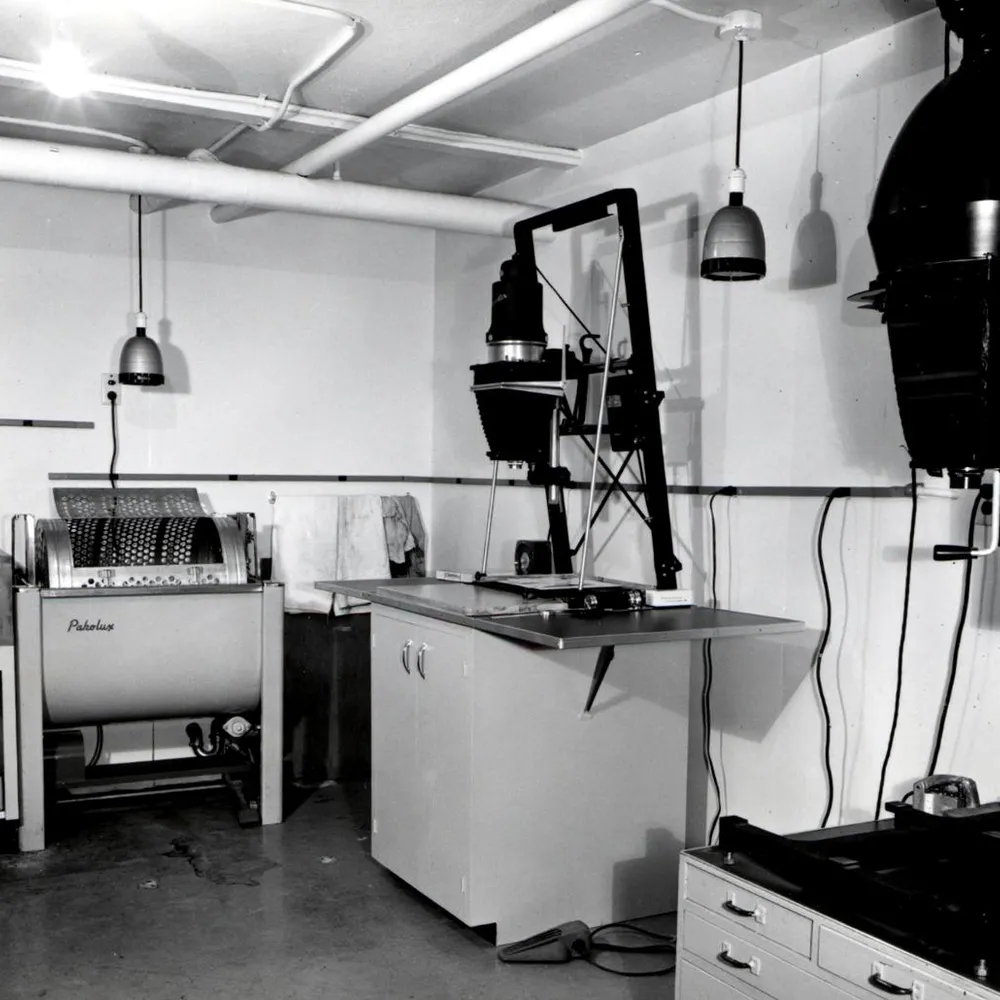
Image: R.B. Pope, Print processing darkroom at Sellwood Laboratory, Portland, Oregon (1956), USDA Forest Service, public domain
· 6 min read
How Ansel Adams treated the negative as a fixed score and the print as performance, holding back and burning in to realize a visualized tonal scale.

· 6 min read
How Bill Brandt traded tonal fidelity for stark blacks, bleached whites, and the steep distortion of a wide-angle police camera.
· 6 min read
How a single hard light, deep shadow and minimal fill build Rembrandt and split lighting, and how the Zone System keeps the dark side readable.
The grainmag companion app
Meter and place your tones without a signal. No account, no internet required — just you, the light, and the grain.