· 6 min read
Bill Brandt: High-Contrast Printing and the Wide-Angle Nude
How Bill Brandt traded tonal fidelity for stark blacks, bleached whites, and the steep distortion of a wide-angle police camera.
Written in by Simon Lehmann Editor
A single negative can yield many prints, and no two need carry the same distribution of tones. Ansel Adams formalised this with a musical analogy in The Print (1983): the negative is the score, and the print is the performance. The negative fixes the information; the print interprets it. The value of that distinction is that it is measurable — both the placement of tones at the camera and their local adjustment under the enlarger are reckoned in the same units, stops and zones. Understanding that arithmetic is what makes dodging and burning acts of realisation rather than guesswork.
The negative records a fixed relationship between scene luminances and silver density, set at exposure and locked by development. The Zone System, developed by Adams with Fred Archer at the Art Center School in Los Angeles around 1939–40 and codified in The Negative (first published 1948, revised 1981), gave that relationship a vocabulary. It assigns Roman numerals to a scale of print tones: Zone 0 is maximum black, Zone V is middle grey, and Zone IX approaches paper-base white. Each zone differs from its neighbour by one stop — a factor of two in luminance — so the whole scale is a ladder of doublings. The textural range, where detail is legible, runs Zone II through Zone VIII; the useful dynamic range of negative densities spans Zone I to Zone IX.
Zone V corresponds to the 18 percent reflectance grey card. There is a well-known wrinkle: reflected-light meters are not calibrated to 18 percent but to a midtone nearer 12–13 percent, following the ISO 2720 reflected-light constant. A metered grey card and a deliberate Zone V placement therefore differ by a fraction of a stop — a caveat worth carrying, not a reason to distrust the system.
The working maxim — expose for the shadows, develop for the highlights — describes how the score is set. Placing a textured shadow on Zone III fixes exposure, since shadow detail underexposed at the toe of the film’s characteristic curve cannot be recovered later. Development then governs the highlights at the curve’s shoulder, which is why it expands or contracts contrast while barely moving the shadows.
The development half of the maxim is the lever most readers leave abstract. It has concrete numbers. Normal development (N) renders the placed zones as visualised. N+1 lifts the high zones one full zone by extending development roughly 30–40 percent; N−1 lowers a Zone VIII placement toward Zone VII density by shortening it roughly 20–30 percent. The effect concentrates at the shoulder because the densest, most-exposed grains keep building with extra agitation and time, while the thin toe densities of the shadows are already near their limit and change little.
Worked in real chemistry: Kodak Tri-X 400 in HC-110 dilution B (1+31) develops around 5–7 minutes at 20°C (68°F) for a normal negative; an N−1 contraction trims that by 20–30 percent. Ilford HP5 Plus in ID-11 1+1 runs about 13 minutes normal at 20°C, stretched toward 17 minutes for an N+1 expansion. The exact figures belong to your own test strips, not a universal table — but the direction and magnitude are fixed: more time, hotter highlights; less time, tamed ones.
A straight print — one uniform enlarger exposure across the frame — renders every value as the negative dictates. Before any local move, the global slope is set by paper grade. Variable-contrast papers such as Ilford Multigrade run from grade 00 (very soft) to grade 5 (very hard) via filtration; split-grade printing makes one exposure through the 00 filter and another through the 5, controlling highlight and shadow contrast independently. Dodging and burning are the local adjustments layered on top of that global choice.
The arithmetic mirrors the camera side exactly. Burning is reckoned as a fraction of the base exposure: adding 100 percent of the base time — a doubling — darkens that area by one stop, one full zone; adding 50 percent is roughly half a stop. Dodging is base time held back over a region, lightening it by the equivalent fraction. A washed-out sky one to two stops too light is brought down by burning in an extra 100–200 percent of the base time, often with a card cut to the horizon line and kept moving so the join does not show.
Adams’s prescribed method follows from this. In The Print he makes a straight work print first — one even exposure — judges it cold, then plans every local move from it. His dodging tools were literally cardboard taped to a stiff wire; burning used cut cards and his hands. The point of the work print is that you cannot meter a performance you have not yet heard.
Moonrise, Hernandez, New Mexico is the worked example. Adams made it on 1 November 1941 with an 8×10 view camera, a Cooke Triple-Convertible lens, and a Wratten No. 15 (G) deep-yellow filter, on ASA 64 film. Unable to find his Weston meter, he recalled the moon’s luminance as 250 c/ft² and placed it on Zone VII — which put 60 c/ft² on Zone V — and with the filter’s 3× factor arrived at roughly 1 second at f/32. He recounts this in Examples: The Making of 40 Photographs (1983).
The negative was thin and difficult to print. In 1948 Adams intensified it — he stated the intensifier was Kodak IN-5, a proportional silver intensifier, not the selenium often assumed — to raise foreground density and ease printing. So the score was, on one occasion, chemically re-edited; the tidy metaphor admits that exception. But the decades of evolution that followed were performance, not chemistry. Adams printed Moonrise more than 1,300 times across roughly four decades, the surviving negative now held in the Ansel Adams Archive at the Center for Creative Photography in Tucson. Early 1940s prints carry a lighter middle-grey sky with bands of cloud detail; later prints burn it progressively toward a near-black void that isolates the moon and the lit crosses below, the moon’s value held constant throughout. Same negative, reread — a different statement each time.
Treating the print as performance reframes the darkroom as an interpretive stage rather than a reproduction step. The negative’s job is to record a full, printable range; development sets how far the highlights climb; paper grade sets the global slope; and dodging and burning move individual regions in stops and zones until the print matches what was visualised. The grammar is the same at both ends of the process — which is exactly why a fixed score can be brought, again and again, to a particular and intended performance.
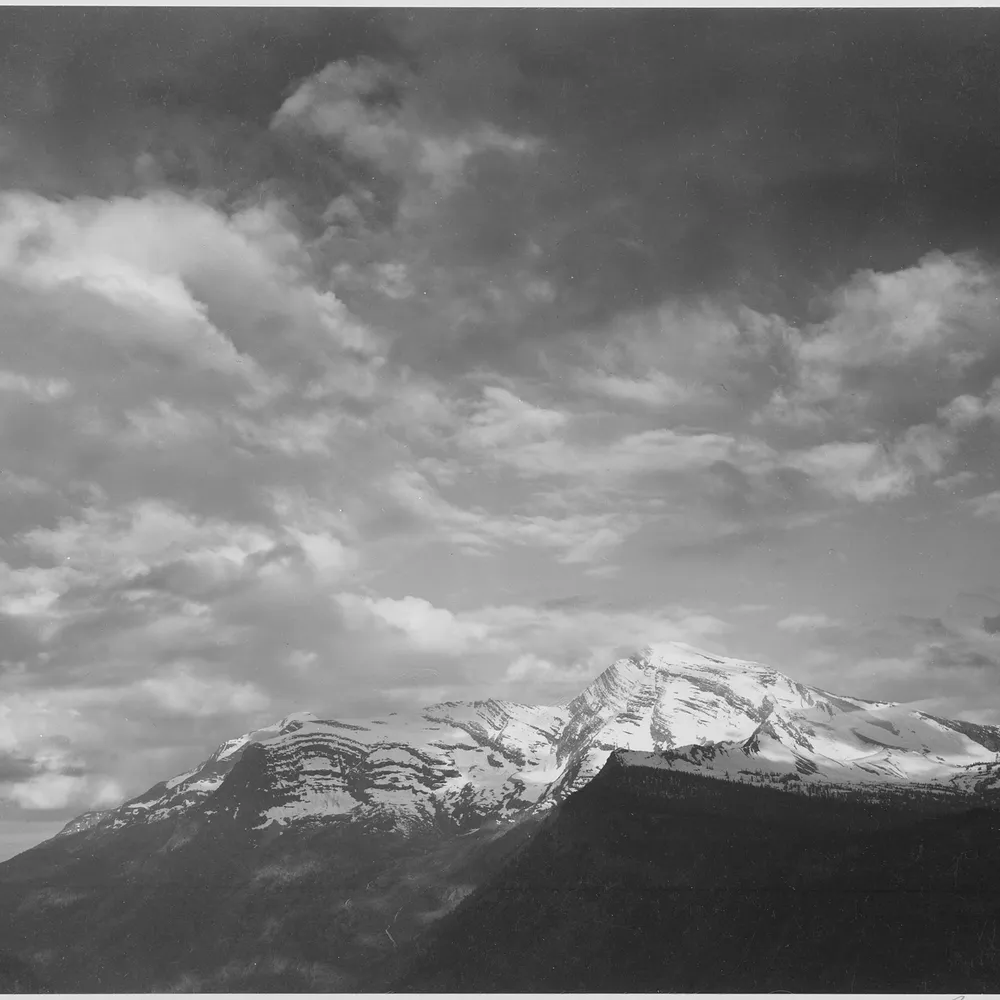
Image: Ansel Adams, Heaven’s Peak, Glacier National Park, Montana (c. 1942), U.S. National Archives (79-AA / NAID 519871), public domain
· 6 min read
How Bill Brandt traded tonal fidelity for stark blacks, bleached whites, and the steep distortion of a wide-angle police camera.
· 8 min read
How Cartier-Bresson fused timing with internal geometry, composing the full 35mm frame in the viewfinder and printing uncropped, with the Leica as a discreet tool.
· 9 min read
How fixed-grade and variable-contrast papers reshape a negative's tonal range, and how enlarger filtration sets contrast under the lens.
The grainmag companion app
Meter and place your tones without a signal. No account, no internet required — just you, the light, and the grain.