· 6 min read
The Negative as Score: Adams, Print Values, and the Logic of Dodging and Burning
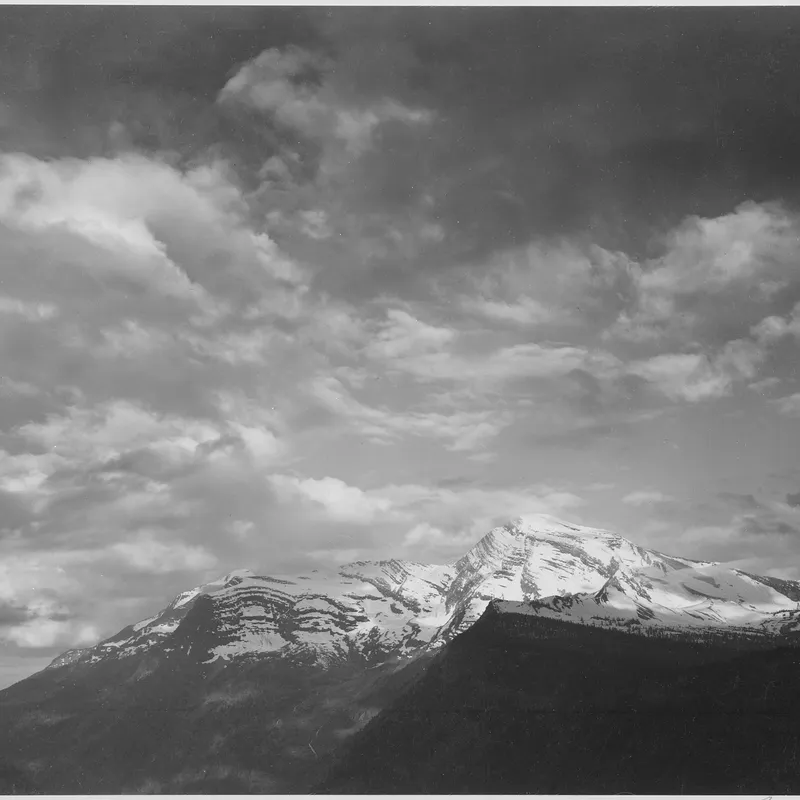
How Ansel Adams treated the negative as a fixed score and the print as performance, holding back and burning in to realize a visualized tonal scale.
Written in by Simon Lehmann Editor
A fibre-based print judged wet under the safelight rarely matches the print held in the hand the next morning. The wet version that looked bright and glowing the previous evening reads dull on drying: the highlights flatten, lose their bite, and close up just enough to disappoint. This shift is called dry-down. Because the judgement is made wet but the result is always viewed dry, the discrepancy is built into the process unless you anticipate it and correct for it deliberately.
The cause is geometric, not a vague “tightening” of the emulsion. When a print is wet, the paper base and the gelatin emulsion swell with water. An unconstrained fibre-based sheet expands by more than 2 per cent when fully wet, the bulk of it from the absorbent fibre base taking up water. That swelling widens the gaps between the developed silver grains. Wider spacing lowers reflection density and raises local contrast in the mid-tones and highlights, so the wet print looks lighter and sparklier than it really is. As the print dries, the emulsion contracts and the silver grains pack closer together: density rises and local contrast falls. That is dry-down.
Two consequences follow from this geometry. First, the full blacks (Dmax) and the paper-base white are essentially unaffected, because they have either no grain spacing left to close or no silver to crowd. The shift lives almost entirely in the mid-tones and the upper-mid tones running into the highlights. That is precisely why highlights lose their sparkle on drying while the deepest shadows look the same. Second, resin-coated papers barely show the effect at all: their polyethylene-laminated base does not saturate, and only the thin emulsion and anti-curl coatings ever contact water, so there is very little base swelling to reverse. Dry-down is therefore a fibre-printing problem.
Mechanism after Yateley Darkroom, “Resin-coated Versus Fibre-based Enlarging Papers”.
The figure usually quoted, 8 to 12 per cent, is widely misread. It is not an 8 to 12 per cent jump in density. It is the reduction in exposure time needed to compensate for the density that drying adds. The reflection-density change itself is far smaller, on the order of a few hundredths of log-D. For scale, the densitometry literature treats a press-density variation of about ±0.05 D as a meaningful unit, read against an unexposed paper-base white using 45°/0° geometry. A dry-down shift can sit at or below that magnitude and still ruin a print, because it lands in the light tones near paper white where the eye is most sensitive to small density differences. A change too small to bother a shadow is glaring in a delicate highlight.
The shift is reproducible for a given paper, developer and drying method, so it can be measured once and treated as a constant. Les McLean’s “Print Dry Down” gives the standard method. Pick your base exposure and make two straight reference prints. Then make a series at the base exposure minus 8, 9, 10, 11 and 12 per cent, pencilling the percentage on the back of each. With a 20-second base the series runs 18.4s (8%), 18.2s (9%), 18.0s (10%), 17.8s (11%) and 17.6s (12%) — ten per cent of 20 seconds is 2 seconds, so 10% gives the familiar 18s. Process every print normally, then dry them all except reference print no. 1, which stays in a holding tray of fresh water. The next day, compare each fully dried print against the still-wet reference. The dried print whose pencilled percentage matches the wet reference is your paper’s dry-down factor.
McLean grounds the 8 to 12 per cent range in 25 years of printing, and retests every paper he uses every 12 months because paper characteristics drift. The factor is genuinely material-specific: Ilford Multigrade FB Classic, Foma Fomabrom and Adox MCC 110 will not share a single number, and you should re-measure when you change developer, change your drying method, or even open a fresh box of the same paper.
Once the factor is known, every printing decision, including all burning and dodging, is still judged on the wet print. The correction is applied only to the final base exposure: reduce it by the measured percentage so that drying brings the print down to the intended density. The 20-second, 10-per-cent example simply prints at 18 seconds.
Contrast needs a second thought, and there is a real mechanism behind it. Because drying raises mid and highlight density faster than it touches the already-dense shadows, it compresses local contrast in exactly the light tones you care about. To restore highlight separation, a correctly compensated dry print often wants roughly a quarter to half a paper grade more contrast, or the equivalent bump in split-grade or Multigrade filtration. Judge that increase on the matched dry print, never guess it on the wet one. The target McLean describes is worth keeping in mind: clean delicate highlights and rich luminous shadows which show just a hint of separation in the darkest part.
You can also sidestep the arithmetic by improving how you look at the wet print. The eye does not adjust quickly from safelight orange to bright white, so a wet print under a harsh white inspection light reads far lighter than it will dry. Judge instead under a dim incandescent source — commonly a low-wattage lamp, around 25 W at six to eight feet — and, where it matters, under light resembling the place the print will finally hang rather than darkroom lighting alone. To see the magnitude before committing to any percentage, take a fully dried print, submerge half of it in water for about thirty seconds, and lay the wetted half against the dry half. The gap between them is dry-down, made visible.
None of the above means anything until the test prints are fully dry. A print read while still damp will under-report the shift, which is exactly how the wet-evening, dull-morning trap is sprung. The drying route is itself a variable: air-drying, heat or flatbed drying, and the paper’s surface finish all change the apparent dry-down, with glossy and matt surfaces behaving differently. Measure under the same drying regime you will use for finished prints, and re-measure if you change it.
References: Les McLean, “Print Dry Down”; Ralph W. Lambrecht & Chris Woodhouse, Way Beyond Monochrome, 2nd ed. (Focal Press), “Print Dry-Down” section; Ansel Adams, The Print, on wet/dry judging discipline.
· 6 min read
How Ansel Adams treated the negative as a fixed score and the print as performance, holding back and burning in to realize a visualized tonal scale.
· 6 min read
How and when to bracket exposures by full and fractional stops, how to set the spread for film versus digital, and when brackets serve as insurance or as blending source frames.
· 9 min read
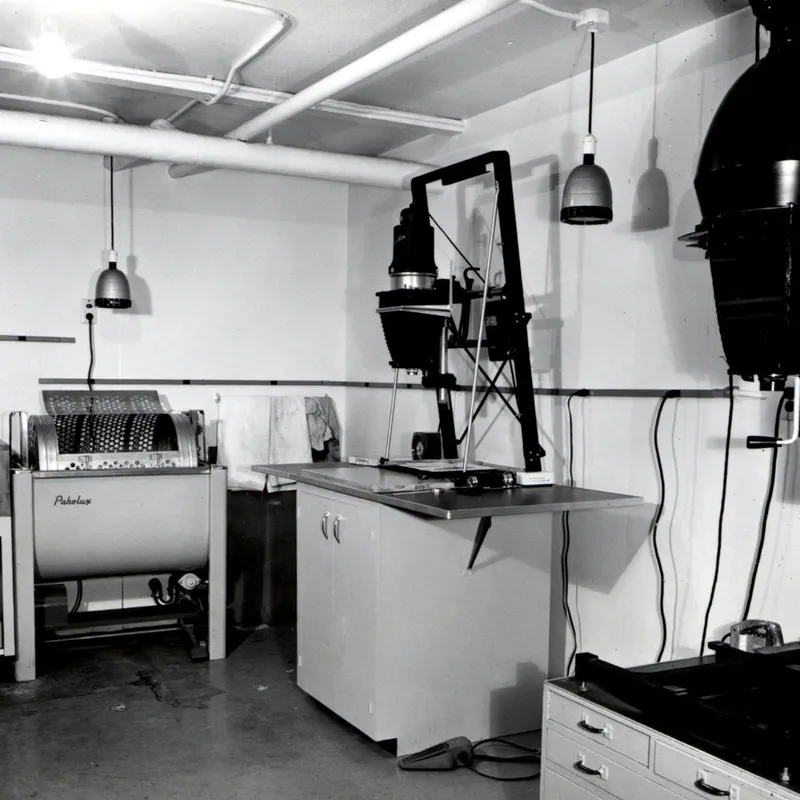
How fixed-grade and variable-contrast papers reshape a negative's tonal range, and how enlarger filtration sets contrast under the lens.
The grainmag companion app
Meter and place your tones without a signal. No account, no internet required — just you, the light, and the grain.