· 7 min read
Archival Washing of Fibre Prints and Residual Hypo Testing
How fixer is removed from a fibre paper base, the role of a hypo clearing agent, water-economical wash sequences, and tests for residual silver and hypo.
Written in by Simon Lehmann Editor
A finished silver print is an image made of fine metallic silver, and metallic silver is the unstable end of the chemistry. Left in air it reacts slowly with atmospheric sulphur compounds and oxidising gases, drifting towards silver sulphide and producing the yellowing, edge fading and surface bronzing seen in untoned prints. Sepia toning by the bleach-and-redevelop process simply takes the image there deliberately and completely. It converts the silver to silver sulphide in one controlled step, so there is little reactive metallic silver left to degrade. Kodak’s Toning Black-and-White Materials (Technical Data G-23, May 2006) describes toning as converting “the black-and-white silver image to an inert compound, which reduces the harmful effects of intense light, ultraviolet radiation, oxidizing gases, extremes of temperature and humidity, and fumes.” The brown colour is the by-product; the stability is the point. The technique dates to roughly the 1880s, when it was adopted as much for permanence as for its appearance.
The process is indirect: it works in two steps rather than acting on the metallic silver in place. The first bath bleaches, built around potassium ferricyanide and a soluble bromide. Ferricyanide is the oxidant. It strips electrons from the metallic silver, is itself reduced to ferrocyanide, and the liberated silver immediately combines with bromide to form silver bromide, a pale cream halide:
4 K₃Fe(CN)₆ + 4 Ag + 4 KBr → 4 AgBr + 4 K₄Fe(CN)₆
The bromide matters. Without it the silver would form something that does not redevelop cleanly; with it, the image is rebuilt as a developable halide. As the bleach works, the print appears to fade almost to nothing, leaving only a faint ghost of the densest tones. The potassium oxalate and acetic acid keep the bath acidic, which holds the ferricyanide stable and stops it decomposing in use.
The print is washed and moved to the redeveloper, a sulphide bath that converts the halide to brown silver sulphide:
2 AgBr + Na₂S → Ag₂S + 2 NaBr
Silver sulphide is the same compound towards which an untoned print slowly degrades, which is why driving the conversion to completion confers permanence rather than just colour.
The standard sulphide formula is Kodak’s Sepia Toner T-7a. The bleach stock is 75 g potassium ferricyanide, 75 g potassium bromide, 195 g potassium oxalate and 40 mL of 28% acetic acid, with water to make 2 litres. For use, dilute 500 cc of stock with 500 cc of water (1+1). The redeveloper stock is 45 g sodium sulphide with water to make 500 mL; for use, take 125 cc of that stock and add water to make 1 litre.
Walking an 8×10 fibre print through the trays: bleach until only a faint yellowish-brown image remains and the shadow blacks have disappeared, about five to eight minutes. Rinse in cold running water for at least two minutes. Transfer to the sulphide bath and tone about 30 seconds, until the original detail returns in brown. Rinse, then harden for two to five minutes, and give a final wash of half an hour in running water. The bleach is the slow step at several minutes; the redevelopment is the fast one at around thirty seconds, and the two times should not be confused.
The single most practical variable is the paper, not the toner. Ilford’s Toning B&W Prints fact sheet (December 2001) is explicit: Multigrade FB Warmtone and Multigrade RC Warmtone are designed to be receptive to all toners and give a warm result, while Multigrade IV papers are designed to resist image-colour change and yield a cold brown. The often-repeated idea that sulphide is intrinsically a “cold” toner is a misreading. The cold brown is a paper-toner interaction: sulphide sepia and non-variable thiourea give a rather cold brown on Multigrade IV but work warmly on the Warmtone emulsions. Choose the emulsion for the colour you want before you reach for a different chemistry. Commercial indirect sulphide kits include Kodak Sepia, Berg Rapid RC Sepia, Photographers’ Formulary Sepia Sulphide 221 and Tetenal Sulphide.
The alternative redeveloper is an alkaline thiourea bath, attractive because it is odourless where sulphide releases hydrogen sulphide. Its real advantage is tuneability. Per the Ilford sheet, the image colour is controlled by the pH of the second bath, set with sodium hydroxide: more sodium hydroxide gives a colder, more yellow tone, less gives a warmer, redder one. Start at the manufacturer’s recommended alkali level, judge a test print, and add or withhold sodium hydroxide to shift the result. Warmtone papers need a larger addition of sodium hydroxide than usual to keep the tone from going too yellow. Thiourea demands care: it is a powerful fogging agent and must be kept well away from unexposed paper and film.
The bleach governs how much of the image is committed to the toner. Bleach to completion and the whole tonal scale converts to a uniform sepia. Stop early, or use a dilute bleach, and the deepest shadows stay as untoned metallic silver while the highlights and mid-tones redevelop brown, giving warm highlights over cool, near-neutral shadows. A roughly 1% working bleach with a little bromide acts slowly enough to interrupt by eye.
For two-toner splits, the Ilford guideline is to reduce the time in the first toner to about 25% of the recommended time, wash the print well, then move to the second bath. The standard pairings: sepia then blue gives sepia highlights, blue shadows and green mid-tones; sepia then selenium gives brown-purples; blue then selenium gives blue shadows with buff highlights.
Indirect sulphide toning lowers density and contrast, so Ilford recommends developing about 50% longer than normal to lay down the slight extra density needed. A stop bath before fixing is essential, two-bath fixing is preferred, and hardening fixers are not recommended. Do not over-fix: G-23 gives roughly ten minutes maximum for fibre-base and two minutes for resin-coated, because trapped thiosulphate reacts during toning and turns the print yellow. Wash fibre prints for one hour with a complete water change every five minutes (four minutes for RC). Toning doubles as an instant test of fixing: an inadequately fixed print stains the moment it enters the toner.
The chemistry carries one specific hazard. Per G-23, never discard a sulphide toner together with a stop bath or fixer, because acid plus sulphide liberates hydrogen sulphide gas. Discard each solution separately and flush the drain with plenty of water. Hydrogen sulphide, and thiourea, both fog unexposed paper and film and will oxidise unprotected silver images, so keep the toning trays away from the enlarging bench and work with good ventilation.
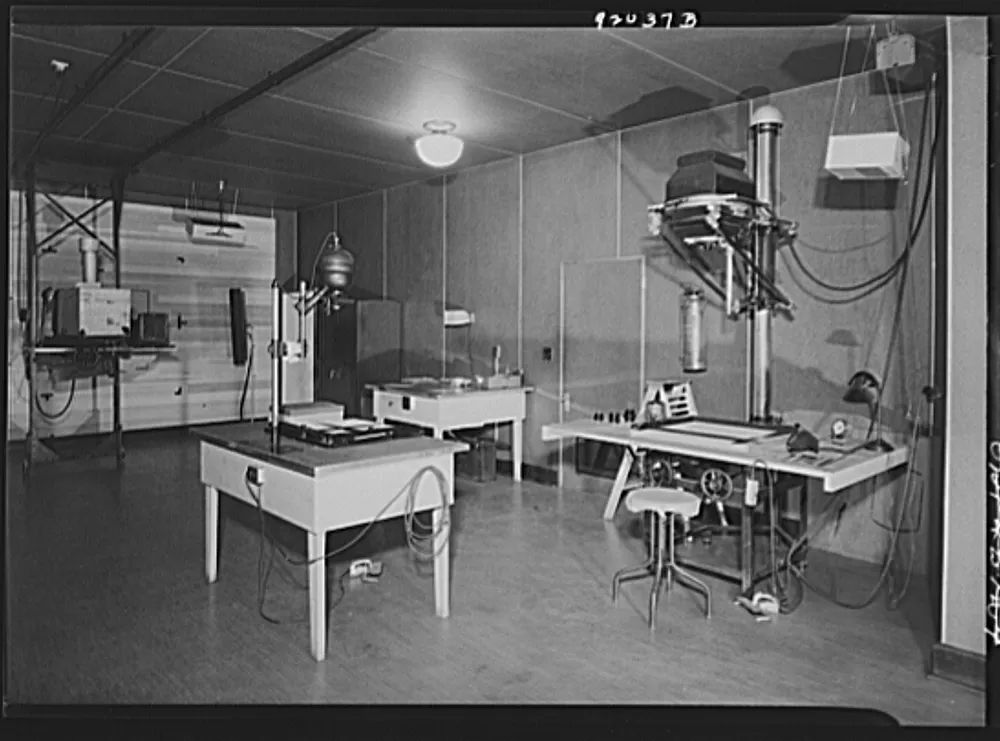
Image: Reginald Hotchkiss, FSA/OWI photograph laboratory mural printing room, Washington, D.C. (1941), U.S. Library of Congress, public domain
· 7 min read
How fixer is removed from a fibre paper base, the role of a hypo clearing agent, water-economical wash sequences, and tests for residual silver and hypo.
· 6 min read
How gold chloride deposits metallic gold over silver to cool a print toward blue, improve permanence, and produce red-chalk tones after sepia.
· 7 min read
How developer chemistry, dilution, temperature and time govern print colour and contrast, and why developing a print fully matters.
The grainmag companion app
Meter and place your tones without a signal. No account, no internet required — just you, the light, and the grain.