
· 6 min read
Fixer Exhaustion and the Clearing-Time Test
Why thiosulfate fixer wears out, how retained silver complexes stain a negative, and the film-clip clearing test that flags a spent bath.
Written in by Simon Lehmann Editor
A fixed print is not yet a permanent one. Fixer dissolves the unexposed silver halides that would otherwise darken in light, but the spent fixer itself becomes a threat. Residual thiosulphate, and the weakly bound silver-thiosulphate complexes formed as fixing proceeds, break down over storage to silver sulphide — the yellow-brown stain of a print left too long in spent chemistry — while any unconverted silver complexes remain as light- and heat-sensitive salts rather than stable metallic image silver. Resin-coated paper holds little chemistry and washes in a few minutes. On fibre-based paper — Ilford Multigrade FB Classic, Foma Fomabrom, Adox MCC 110, and the like — the chemistry soaks into the absorbent baryta-coated cotton base, and getting it out again is the central problem of archival printing.
The cleanest wash begins at the fixer tray. Ilford Rapid Fixer (and its near-twin Hypam) carries two published working strengths, and the choice between them is the choice between commercial and archival keeping. At 1+9 — “paper strength”, about two minutes — a litre will fix roughly 36 to 40 sheets of 8x10 before exhaustion: economical, and adequate for prints you do not need to outlive you. At 1+4 — “film strength”, about one minute — the same litre is rated for only about ten 8x10 sheets, and that lower capacity is the point. A fixer worked past its optimum-permanence capacity stops doing the second half of its job: it converts the halides to silver-thiosulphate complexes but cannot dissolve them fully to washable form, so they stay lodged in the base where no amount of water will reliably shift them. “Fresh, properly diluted, minimum time” is meterable advice: 1+4, one minute, and no more than ten sheets to the litre.
The capacity limit is why archival workers fix in two baths rather than one. The print goes first into bath one, which does the bulk of the work and steadily accumulates dissolved silver. It then moves to bath two, which is kept near-fresh and therefore holds very little silver. Because the silver concentration in that second bath stays low, the weakly bound silver-thiosulphate complexes remain genuinely soluble and the print leaves the fixer carrying the smallest practical silver load — exactly the condition a wash can clear.
The rotation, after Kodak’s scheme, keeps the system honest: when bath one is exhausted it is discarded, bath two is promoted to bath one, and a fresh bath two is mixed. Kodak rates this cycle for about four rounds before both baths are replaced together. Two-bath fixing is the practical form of the principle that reducing the load at source repays itself many times over at the wash stage.
Washing is diffusion-limited. Thiosulphate leaves the fibre base no faster than fresh water can carry away the laden boundary layer sitting against the paper, so the useful work is in exchanging that water, not merely circulating it. A print sitting in a static tray of its own thiosulphate cleans very little; periodic complete water changes — fill, agitate, dump, refill — flush the laden water far more effectively than a slow continuous trickle, and use a fraction of the water doing it. Temperature matters for the same reason: warmer water diffuses faster, which is why Ilford specifies its sequence at 18–24 degC (65–75 degF) rather than straight from a cold tap.
A washing aid, or hypo clearing agent, short-cuts the diffusion problem chemically. Ilford describes Washaid as “a hypo-eliminator formulated to aid the efficient removal of the thiosulphate by-products of fixation by ion exchange”: a strong sulphite bath drives the thiosulphate out of the gelatin and base by sheer concentration gradient and ionic competition, substituting ions that themselves wash out readily. It is, in Ilford’s words, “particularly beneficial if a hardening fixer has been used”, since hardened gelatin gives up its chemistry more reluctantly, and it “saves time and water”. Kodak Hypo Clearing Agent and Heico Perma Wash do the same job by the same mechanism.
The payoff is concrete. Without an aid, a fibre print needs on the order of 60 minutes of running water at temperature to approach archival residual levels. Ilford’s optimum-permanence sequence reaches a comparable result in roughly 20 minutes of wash plus a 10-minute Washaid bath, at far lower water use: fix in Rapid Fixer or Hypam at 1+4 for one minute, first wash five minutes in fresh running water, 10 minutes in Washaid at 1+4 with intermittent agitation, then a final wash of five minutes. There is no archival gain in over-fixing or in leaving prints in the wash for hours — Ilford warns that prolonged fixing can etch or bleach the image, and long soaking only softens the emulsion.
Selenium toning earns its place in an archival sequence before it ever touches print colour. It converts metallic image silver to silver selenide (polysulphide toners convert it to silver sulphide), and both compounds resist oxidation and atmospheric pollutants far better than bare silver does. The protection is dose-dependent: a brief, very dilute pass — Kodak Rapid Selenium Toner is used anywhere from about 1+3 to 1+20 — protects only partially, and full archival protection needs conversion closer to completion. In Ilford’s optimum-permanence sequence toning sits directly after fixing and before the first wash; because the toner adds its own chemistry to clear, the final wash is extended from five minutes to about 30.
Take a single 8x10 print on Ilford Multigrade FB Classic. Fix it two-bath in Rapid Fixer at 1+4, roughly 30 seconds a bath, well inside the ten-sheet-per-litre budget on each. First wash, five minutes in running water at 20 degC. Then 10 minutes in Washaid at 1+4, agitating intermittently, followed by a five-minute final wash. To check the result, mix Kodak HT-2 — 750 ml water, 125 ml of 28% acetic acid, 7.5 g silver nitrate, then water to make one litre — and put a single drop on a clear, unimaged corner of the white border. Leave it two minutes, blot, and read it promptly against the graded patches of the Kodak Hypo Estimator before the stain darkens with time. A faint patch within the “commercial” limit means residual thiosulphate is present but tolerable for ordinary keeping; for archival keeping you want a stain at or below the more demanding patch — effectively imperceptible. A heavy brown spot means more washing, or a fresher fixer, before this print is finished.
To check fixing rather than washing, Kodak ST-1 does the complementary job: a stock of 2 g anhydrous sodium sulphide in 100 ml water, used one part to nine, dropped on a clear margin. More than a faint cream or tan tint indicates silver left behind by inadequate fixing. Handle both reagents with care — silver nitrate stains skin (and everything else) brown, and sodium sulphide gives off toxic, foul-smelling fumes.
Spot tests tell you whether a print passed; the standards say what passing means, and they are not the same document. ISO 18917:1999 (which superseded ISO 417 and corresponds to the former ANSI PH4.8) is a method standard: it specifies how to measure residual thiosulphate and related chemicals — the iodine-amylose, methylene-blue and silver-sulphide densitometric procedures, methylene-blue being the sensitive one for the low residuals that matter for film. The acceptance limits live elsewhere, in the ISO 18901 / 18920 / 18929 family (historically ANSI IT9.1 and IT9.16). For archival film the residual-thiosulphate ceiling is commonly cited at 0.014 g/m² of thiosulphate ion in a clear area; prints carry their own, higher limits in the print standard, read by silver-sulphide densitometry. That is what “so little chemistry that no reaction of consequence can occur” actually means: a number, measured against a standard, rather than a hope.
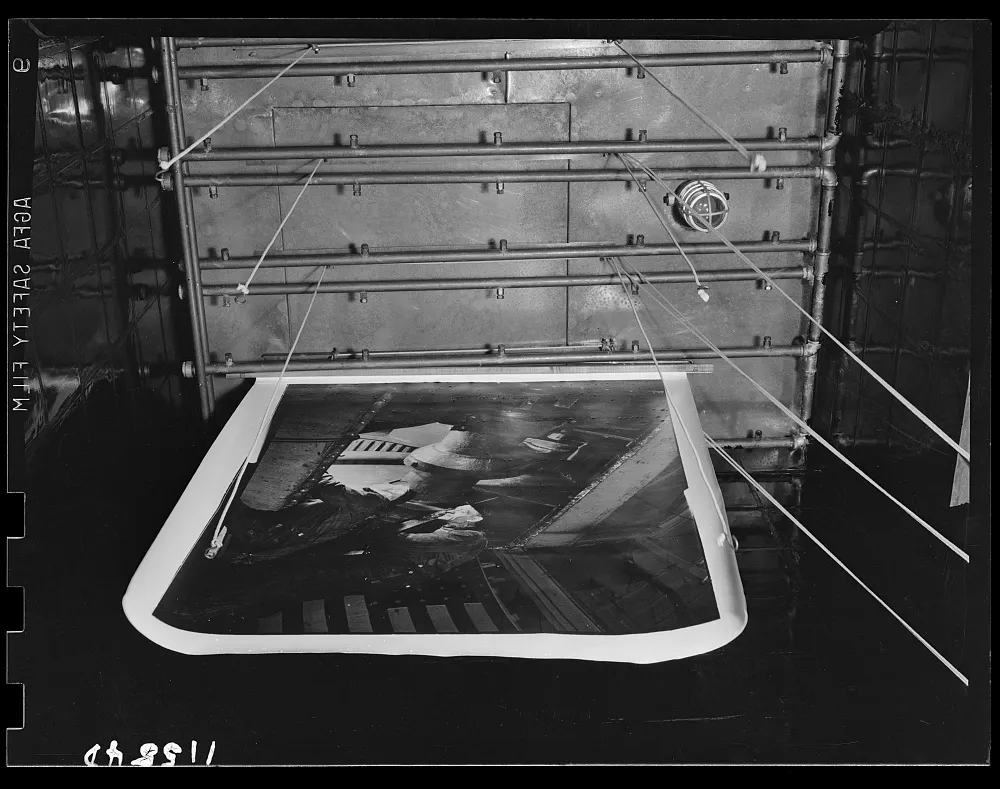
Image: John Ferrell, Shower bath print washer in the FSA photographic laboratory, Washington, D.C. (1942), U.S. Library of Congress, FSA/OWI Collection, no known restrictions on publication
· 6 min read
Why thiosulfate fixer wears out, how retained silver complexes stain a negative, and the film-clip clearing test that flags a spent bath.
· 6 min read
How gold chloride deposits metallic gold over silver to cool a print toward blue, improve permanence, and produce red-chalk tones after sepia.
· 7 min read
How developer chemistry, dilution, temperature and time govern print colour and contrast, and why developing a print fully matters.
The grainmag companion app
Meter and place your tones without a signal. No account, no internet required — just you, the light, and the grain.