
· 6 min read
Bill Brandt: High-Contrast Printing and the Wide-Angle Nude
How Bill Brandt traded tonal fidelity for stark blacks, bleached whites, and the steep distortion of a wide-angle police camera.
Written in by Simon Lehmann Editor
A blue sky and white clouds are clearly distinct to the eye, yet panchromatic film often records them as a similar pale grey. The sky dissolves into the clouds because it is made almost entirely of scattered blue light, and the emulsion is well able to see it. A coloured contrast filter is the tool that separates the two again, and to use one deliberately you need to understand what the sky is physically made of, what your film can see, and what it costs you in exposure.
The sky is blue because of Rayleigh scattering: air molecules scatter short wavelengths far more strongly than long ones, with an intensity that falls off as the inverse fourth power of wavelength. Take blue at 450 nm against red at 650 nm and the ratio is (650/450)^4, roughly 4.3 — blue is scattered about four times as strongly as red. Against deep red at 700 nm the ratio climbs to (700/450)^4, close to 5.8. A clear daytime sky is therefore not a surface reflecting a colour; it is scattered blue light, spread across the whole dome.
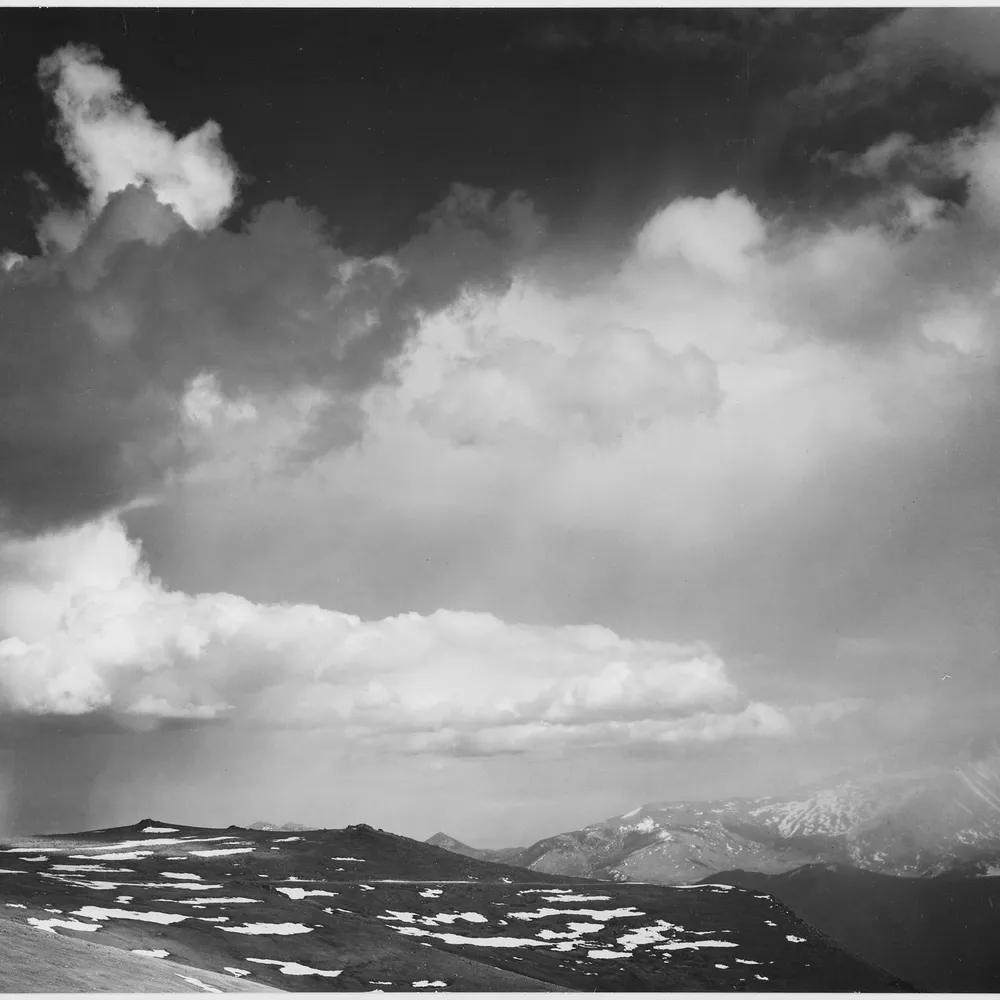
That single fact explains everything a red filter does to it. A red filter removes the blue band, which is the band the sky is made of, so the sky has almost nothing left to expose the film and collapses toward black. A cloud is different: it scatters all wavelengths roughly equally and reflects the full spectrum, including the long red wavelengths the filter passes freely, so it stays near white. Two tones that read as nearly equal on unfiltered film are driven apart precisely because the sky is monochromatic blue and the cloud is not.
Coloured contrast filters only became meaningful once film could see across the spectrum. Early emulsions were orthochromatic — sensitive only to blue and some green, blind to red — which is why skies in 19th- and early-20th-century photographs are almost always blank white: the blue sky massively overexposed a blue-sensitive emulsion while red subjects recorded as near black. Hermann Wilhelm Vogel discovered dye sensitisation in 1873, extending response into green and then red, and commercial panchromatic film followed around 1904–1906. A red filter on ortho film would have done nothing useful, because the film never saw red to begin with.
On a modern panchromatic stock — Ilford HP5 Plus, FP4 Plus, Kodak Tri-X — the emulsion responds from blue through red, so a filter can now redistribute tones rather than simply discard them. The complementary-colour rule is straightforward: a filter lightens its own colour and darkens its complement. A red filter (Wratten 25, the “A” filter) passes long wavelengths above roughly 580–600 nm and absorbs blue and most green, so red and orange subjects lighten while blue ones darken. The same logic runs through the whole set, and it is worth illustrating more than once: a green filter (Wratten 11) lightens foliage and separates leaves from blossom, while rendering Caucasian skin in a darker, more textured tone; a blue filter (Wratten 47) lightens its own colour and accentuates atmospheric haze rather than cutting through it.
Ilford’s descriptions map cleanly onto the standard Kodak Wratten contrast filters. A yellow filter — Wratten 8, the K2 — darkens blue sky modestly, improves penetration of haze and fog, and gives more natural flesh tones; it is the mildest correction and lifts clouds without melodrama. An orange filter (Wratten 16 light orange, or 21/22) records blue skies in very dark tones. A red filter (Wratten 25, or the deep red Wratten 29 used for tricolour work) records the sky as black on the print — Ilford’s “impending thunderstorm” effect. Green is Wratten 11 or 13; blue is Wratten 47. Naming the number matters because it is what you actually order and screw onto the lens; “a red filter” is not a specification.
In Zone System terms this is how you describe a sky being “driven apart”: a deep red filter typically pushes a clear blue sky three to four stops — three to four zones — below where it would have rendered unfiltered, dropping a sky that metered around Zone VI down toward Zone II or below. That is the precise version of the loose phrase “near black,” and it is the language Adams used to plan a negative before tripping the shutter.
Because a filter removes light, it demands extra exposure, expressed as a filter factor where factor = 2^(stops): a factor of 2 is one stop, a factor of 4 is two stops. Ilford lists a factor of 2 for yellow, 4 for orange, 4 to 5 for red, 2 for green and 2 for blue (in practice Ilford recommends adding about +1 stop for orange and +1 to +2 for red, slightly less than the nominal arithmetic).
Work it through. Meter the unfiltered scene on FP4 Plus and suppose it reads 1/250 s at f/11. Fit a red Wratten 25 with a factor of 4 — two stops — and you can give 1/60 s at f/11, or equivalently hold the shutter and open up to 1/250 s at f/5.6. An orange Wratten 16 at a factor of 2 wants one stop: 1/125 s at f/11. A yellow Wratten 8 at a factor of 2 likewise takes one stop.
Two cautions belong here. First, the filter factor is not a fixed property of the glass; it depends on the film’s spectral sensitivity and on the light source, daylight versus tungsten. Prefer the factor printed in your film’s datasheet over a generic chart. Second, do not trust through-the-lens metering with a deep red filter on the lens. A meter’s spectral response differs from the film’s, especially out at the red end, so the meter mis-weights the light it sees through the filter. Meter the scene unfiltered, then apply the factor by hand.
The drama has a cost, and it is concrete rather than rhetorical. Because a deep red filter removes nearly all blue, everything lit chiefly by blue skylight darkens along with the sky — not only the sky itself. Open shade, the shadow side of snow, foliage shadows, and water reflecting the sky are all illuminated by scattered blue, so they too plunge toward black. Shadow detail you meant to keep can collapse entirely. This is the real trade-off behind “drama versus control”: a Wratten 25 or 29 buys a thunderous sky at the price of the low values across the rest of the frame.
Ansel Adams understood this exactly. He made Monolith, the Face of Half Dome on 17 April 1927 from the Diving Board on the LeConte Gully route, using a 6.5 × 8.5-inch Korona view camera on Wratten panchromatic glass plates. He first exposed a plate through a Wratten 8 (K2) yellow filter, which rendered the hazy sky roughly as the eye saw it; then, for the final plate, he switched to the deep-red Wratten 29 to darken the sky to near black, matching the image he had already pictured in his mind rather than the one in front of him. That deliberate departure from the literal scene is the moment Adams is credited with articulating visualisation — and it is impossible without knowing, before the exposure, exactly what the filter will take away.
Image: Ansel Adams, “Mountain Tops, Low Horizon, Dramatic Clouded Sky, In Rocky Mountain National Park, Colorado” (c. 1933–1942), U.S. National Archives, public domain
· 6 min read
How Bill Brandt traded tonal fidelity for stark blacks, bleached whites, and the steep distortion of a wide-angle police camera.
· 6 min read
Why the blue filter exaggerates atmospheric haze and softens distance in black-and-white, and how it recreates the rendering of early orthochromatic emulsions.
· 6 min read
How weighting red, green and blue channels in conversion reproduces the effect of physical filters, and where sensor color response sets the limits.
The grainmag companion app
Meter and place your tones without a signal. No account, no internet required — just you, the light, and the grain.