· 6 min read
The Negative as Score: Adams, Print Values, and the Logic of Dodging and Burning
How Ansel Adams treated the negative as a fixed score and the print as performance, holding back and burning in to realize a visualized tonal scale.
Written in by Simon Lehmann Editor
The contrast of a black and white print is set where the negative’s density range meets the paper’s exposure scale, and the paper is the part of that pairing you choose at the enlarger. A negative carries a fixed negative density range (NDR) between its thinnest shadow and densest highlight, measured in log-exposure units on a densitometer. The paper has a log-exposure range (LER): the span of light it can record between paper-white and maximum black. Match a high-contrast grade to a flat negative and you stretch its tones; match a soft grade to a contrasty negative and you fold the extremes back into the printable scale. Two families of enlarging paper offer different routes to that match: fixed-grade paper, manufactured in discrete contrast grades, and variable-contrast (VC) paper, in which contrast is set by filtration. The choice shapes workflow, consistency and the local manipulation possible under one exposure.
Fixed-grade paper carries a single emulsion whose contrast is set during manufacture, in a numbered series from grade 0 (soft, low contrast) to grade 5 (hard, high contrast). Grade 2 is the convention for normal, and that convention is anchored to the negative: in Ansel Adams’ Zone System, described in The Negative and The Print, film exposure and development are aimed at a highlight density that prints correctly on grade 2 paper. A flat negative is then printed on a harder grade to expand its tonal separation; a contrasty one on a softer grade to hold detail in both shadows and highlights.
Variable-contrast paper carries two emulsions of differing colour sensitivity coated on one sheet, and it is orthochromatically sensitised, so it can be handled under a red safelight and responds only to green and blue light. The green-sensitised emulsion is the low-contrast component and the blue-sensitive emulsion is the high-contrast component, as Ilford’s MULTIGRADE RC Papers documentation sets out. Yellow filtration subtracts blue, favouring the soft green layer and lowering contrast; magenta filtration subtracts green, favouring the hard blue layer and raising it. Foma’s FOMABROM VARIANT III datasheet describes the same orthochromatic, yellow/magenta arrangement for its fibre-based VC paper. One box of paper therefore covers the whole grade range, selected by below-lens filters or a dialled colour head.
To map a measured negative to a filter, manufacturers publish an ISO Range (R) figure for each grade, defined under ISO 6846:1992 as the log-exposure range that grade will print, multiplied by 100. Ilford’s own worked example: a negative with an effective density range of 1.32 log-exposure units, multiplied by 100, gives 132; pick the nearest published ISO Range and print through that filter. For MULTIGRADE IV RC DELUXE the per-filter ISO Range runs 00 = 180, 0 = 160, 1 = 130, 2 = 110, 3 = 90, 4 = 60, 5 = 40. The nearest figure to 132 is 130, so that negative wants the grade 1 filter. The reformulated MULTIGRADE RC DELUXE shifts the scale (00 = 160, 0 = 130, 1 = 110, 2 = 90, 3 = 70, 4 = 60, 5 = 50), so a densitometer reading does not transfer between paper generations without re-checking the table.
Note how small the numbers are in absolute terms: paper records a far shorter scale than film. Multigrade RC has an approximate equivalent film speed of only ISO 3 to 6, which is why enlarging exposures run in seconds, not fractions, and why an exposed sheet can sit up to 24 hours before processing with no meaningful change in image quality.
Ilford’s Multigrade filter set is numbered 00 to 5 in half-grade steps, twelve filters in total, the lowest number softest. The exposure behaviour is quantised, not gradual: filters 00 to 3.5 share one exposure time, and filters 4 and 5 need roughly double, about +1 stop. The reason is in the published ISO Speed (P) figures. For MULTIGRADE IV RC DELUXE, P is 200 across filters 00 to 3 and drops to 100 for filters 4 and 5; the harder grades draw their contrast almost entirely from the slower blue-sensitive emulsion, halving the speed. The practical rule: change grade anywhere from 00 to 3.5 and keep your time; cross to grade 4 or 5 and add a stop, then refine with a test strip.
Those figures, and the paper’s characteristic curves, are quoted against a defined process. The Ilford datasheet develops MULTIGRADE RC in MULTIGRADE developer at 1+9 for 1 minute at 20C/68F (or 1+14 for 1 minute 30 at the same temperature). Hold that process constant: changing developer dilution, time or temperature shifts where each grade lands, so a contrast comparison only means something against a fixed bench process.
A single VC sheet supports split-grade printing, popularised in the UK by printer Les McLean and the subject of Ilford’s own split-grade technical article. The method uses just two filters, grade 0 and grade 5, made as two separate exposures onto one sheet. The soft grade 0 exposure, found with its own test strip, sets the highlights and upper midtones; the hard grade 5 exposure, found with a second test strip, sets the depth of the blacks.
The exposures act semi-independently because the two emulsions have different characteristic curves. Grade 0 light is recorded almost entirely by the soft green-sensitive emulsion, whose curve rises gently and reaches its useful density in the upper tones; grade 5 light is recorded by the hard blue-sensitive emulsion, whose steep curve does most of its work in the shadows. So the grade 0 exposure moves the highlights with little effect on already-dense blacks, and the grade 5 exposure deepens the blacks with little effect on the highlights. That near-orthogonal control is what makes split-grade, and the dodging and burning built on top of it, so flexible.
Fixed-grade paper offers consistency and economy of process. With no filtration in the light path it is simpler to expose, marginally faster, and less prone to safelight fogging, and the grade can never be set by accident. Its limitation is granularity and, increasingly, supply: contrast moves in whole grades, and the once-complete 0-to-5 ranges have contracted to a handful of products. As of 2024 to 2026, Ilford Galerie FB is effectively gone, surviving only as old stock; Ilford Ilfospeed RC Deluxe is offered only in grades 2 and 3; Foma still makes genuine graded papers, including a grade 2 Retro; and Slavich is the other graded survivor, no longer distributed in the US. Watch the naming: Adox MCC is a variable-contrast paper, not a graded one.
Variable-contrast paper trades a little simplicity for that flexibility, with half-grade matching, split-grade control and a single stock that covers everything from soft portraiture to hard recovery of a thin negative. That, more than anything, is why VC has become the darkroom standard while true graded paper has narrowed to a short list of survivors.
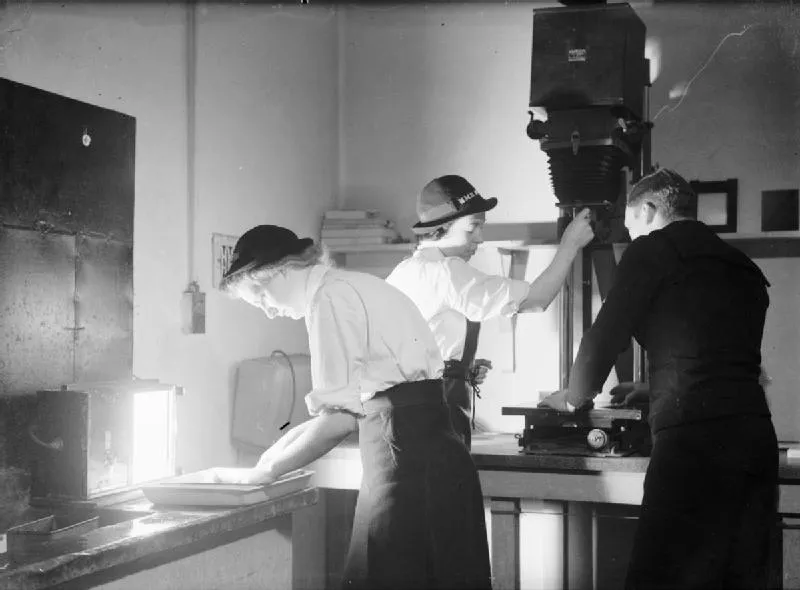
Image: Royal Navy official photographer, Wrens training as photographic assistants, enlarging and developing prints, RNAS Donibristle (1942), Imperial War Museums via Wikimedia Commons, public domain
· 6 min read
How Ansel Adams treated the negative as a fixed score and the print as performance, holding back and burning in to realize a visualized tonal scale.
· 9 min read
How fixed-grade and variable-contrast papers reshape a negative's tonal range, and how enlarger filtration sets contrast under the lens.
· 6 min read
How the baryta-and-paper construction of fibre prints differs from the plastic-sealed RC base, and the consequences for washing, drying and archival life.
The grainmag companion app
Meter and place your tones without a signal. No account, no internet required — just you, the light, and the grain.