· 5 min read
Acros II Reciprocity: Why Metered Exposure Holds Into Multi-Second Territory
How Fujifilm Neopan 100 Acros II resists reciprocity failure to 120 seconds, and what its Super Fine-Sigma grain delivers.
Written in by Simon Lehmann Editor
Grain is usually framed as a defect to be suppressed, a noise floor between the image and the smooth tonal surface that fine-grain emulsions promise. Yet a long strand of black-and-white practice treats coarse grain as the subject’s skin rather than an obstacle: a structure that reads as energy, atmosphere and immediacy. Understanding when grain becomes texture, and how speed and development drive it, separates an accidental rough negative from a deliberate one.
A processed black-and-white image is not continuous tone. It is a scatter of opaque silver filaments, the developed remains of light-struck silver halide crystals suspended in gelatin. Their size and clumping determine how the image disintegrates under magnification. The standard way to quantify this is diffuse RMS granularity: the root-mean-square fluctuation in optical density, measured by a microdensitometer through a 48-micrometre (0.048 mm) circular aperture on an area developed to a mean density of 1.0, then multiplied by 1000. A granularity figure of 10 therefore means a measured RMS density fluctuation of 0.010 in that standard aperture. When the silver clumps are small the aperture averages many of them and the fluctuation is low; when clumps are large, fewer fall within it, so the random variation, and the granularity number, rises. The 0.048 mm aperture is no round figure: it traces back to a drill bit a Kodak employee happened to use.
The figures depend on development, so they only mean anything when the conditions are stated. Kodak’s datasheet for Professional Tri-X 400, the 400TX emulsion, in publication F-4017 (February 2016) lists a diffuse RMS granularity of 17, classed Fine, read at net diffuse density 1.0 through the 48-micrometre aperture at 12x magnification, with the film developed in HC-110 dilution B at 20C/68F. The same datasheet gives resolving power figures of about 50 lp/mm against a low-contrast target and 100 lp/mm against a high-contrast one, which is worth keeping separate: granularity is grain, resolving power is sharpness, and a coarse-grained look can sit alongside perfectly respectable edge detail.
The cleanest illustration of the speed-grain coupling is to hold the ISO constant and change only the crystal geometry. Tri-X 400 and T-Max 400 are both nominally ISO 400, yet Tri-X measures RMS 17 and T-Max 400 measures 10 on Kodak’s datasheet F-4043. The difference is structural. Tri-X uses conventional cubic, pebble-like crystals; T-Max 400 uses Kodak’s flat tabular-grain (T-GRAIN) emulsion, in which the crystals are thin plates that present far more surface area to light per unit of silver. Less silver is needed for the same speed, the developed clumps are smaller, and granularity falls accordingly. The 10-versus-17 gap is that mechanism made into a number.
Apparent grain is then a question of how hard you magnify what is already on the negative. The silver crystals are the same physical size whatever the format. A 35mm frame is 24x36 mm; a 6x6 frame is 56x56 mm. To reach the same print size, the 35mm negative must be enlarged about one and a half times harder on the long dimension than the medium-format one, so the identical emulsion shows correspondingly more apparent grain on 35mm. The coarse look of street work is partly the emulsion and partly the simple arithmetic of small negatives blown up large.
Pushing means rating a film above its box speed and compensating with longer development. Each stop of underexposure halves the light reaching the shadows, so shadow detail thins; extending development cannot recover what was never recorded there, but it builds the midtones and highlights, raising contrast and clumping the silver into a coarser, more emphatic structure. Ilford HP5 Plus is built for this, rated nominally ISO 400 and, in Ilford’s own words, formulated to respond well to push-processing and to be rated up to EI 3200.
A reproducible example: shoot HP5 Plus at EI 1600, two stops under box speed, and develop in Ilford Microphen stock for 11 minutes at 20C, or in Ilfotec DD-X at 1+4 for 13 minutes at 20C. Ilford extends those times only modestly for EI 3200, to 16 minutes in Microphen and 20 in DD-X, which tells you the extra stop is bought largely from the shadows rather than from a proportionate increase in development. Tri-X behaves similarly when pushed to EI 1600 in HC-110. Note that Ilford, unlike Kodak, does not publish RMS granularity figures, so the texture there is judged by eye rather than by datasheet.
The developer governs how plainly the existing structure shows. Kodak D-76 and the equivalent Ilford ID-11 are metol-hydroquinone formulas carrying roughly 100 g/l of sodium sulphite. Sulphite is a silver-halide solvent, with maximum solvency around 75 g/l; above that threshold it dissolves crystal edges and rounds the clump boundaries, which is the origin of D-76’s reputation as a moderate fine-grain developer. Rodinal, the para-aminophenol developer Agfa introduced in 1891 and now sold as Adox Rodinal or R09 One Shot, does the reverse: used dilute at 1+50 or 1+100 it carries almost no sulphite solvent action and relies on edge effects that leave grain sharp-edged and pronounced. For coarse texture by design, dilute Rodinal and a high-energy push are working with the grain; D-76 is working to soften it.
If you want grain that reads coarser still, the purpose-built fast emulsions go further than a pushed 400 film. Kodak T-Max P3200 (TMZ) has a true speed nearer EI 800-1000 but is designed to be exposed at EI 3200 and above; Ilford Delta 3200 sits near a true ISO 1000. Both are engineered around very high speed rather than pushed into it, and their grain reads accordingly.
The expressive use of this texture lives in the print as much as the negative. Bill Brandt, who from the mid-1950s favoured a far harder black-and-white effect than the muddy prints of his earlier documentary years, printed on grade 4 extra-hard paper, cropped aggressively under the enlarger, and exploited coarse grain for graphic effect, work gathered in his 1966 book Shadow of Light (The Bodley Head). The mechanism behind the grade-4 choice is straightforward: a hard paper grade steepens the local print gamma, so the small density fluctuations of the negative’s grain are multiplied into much larger print-density differences, while midtone separation collapses. Grain is left as the dominant surface and the blacks go rich and detail-less.
The strongest statements came from the street. Robert Frank shot The Americans on a 35mm Leica; published in France as Les Americains in 1958 and in the United States in 1959 with Jack Kerouac’s introduction, its prints were attacked by contemporary critics as flawed by meaningless blur, grain, muddy exposure, drunken horizons and general sloppiness, the very available-light qualities later read as authenticity. A decade on, the Japanese Provoke group made grain a programme. Founded in 1968 by Koji Taki, Takuma Nakahira, Yutaka Takanashi and Takahiko Okada, with Daido Moriyama joining from the second issue, the magazine ran to just three issues (1 November 1968, 10 March 1969, 10 August 1969) in editions of about 1,000 copies. Its aesthetic, are-bure-boke, grainy, blurred and out of focus, was built on Tri-X shot in 35mm and half-frame and home-developed, turning high grain, motion blur and missed focus into a deliberate language rather than a fault.
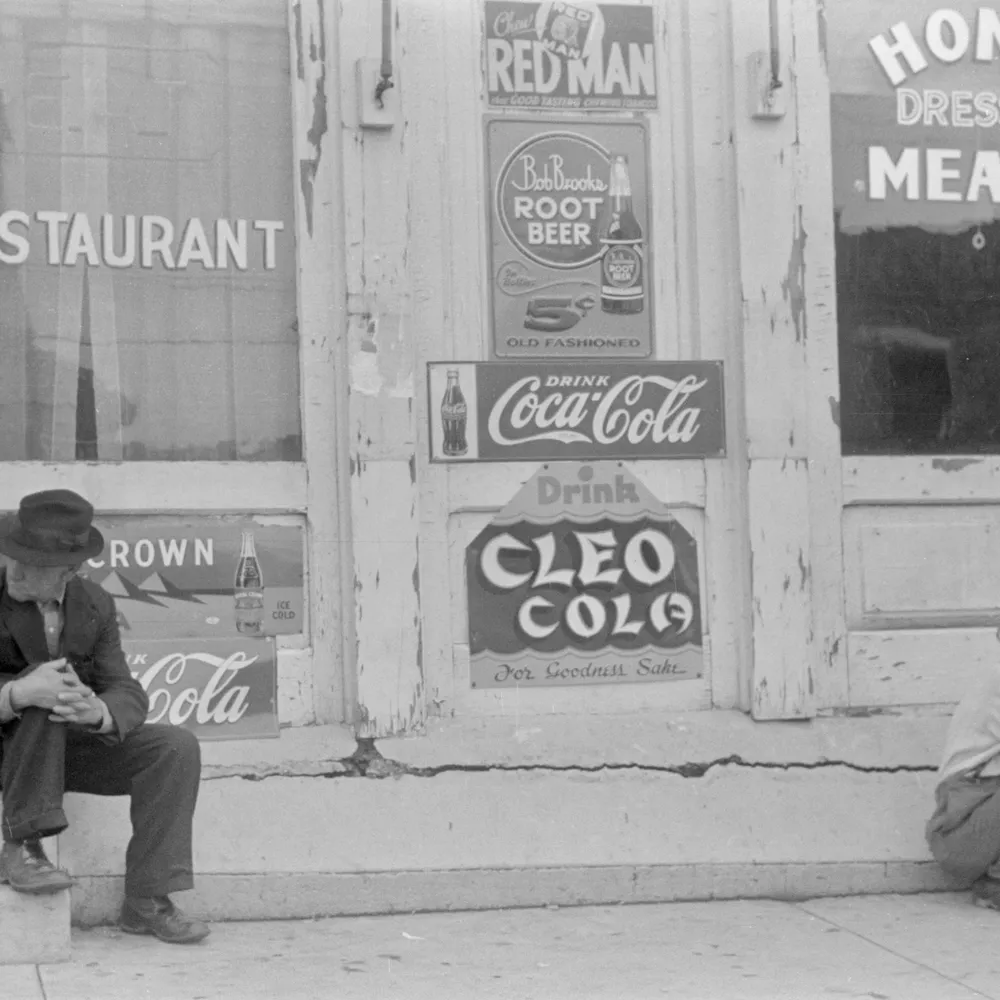
Image: Ben Shahn, Street scene, Worthington, Ohio (1938), Farm Security Administration / U.S. Library of Congress, public domain
· 5 min read
How Fujifilm Neopan 100 Acros II resists reciprocity failure to 120 seconds, and what its Super Fine-Sigma grain delivers.
· 6 min read
How inversion, twirl, and rotary agitation move developer across the emulsion, the patterns they leave, and how each shapes evenness and contrast.

· 8 min read
How Cartier-Bresson fused timing with internal geometry, composing the full 35mm frame in the viewfinder and printing uncropped, with the Leica as a discreet tool.
The grainmag companion app
Meter and place your tones without a signal. No account, no internet required — just you, the light, and the grain.