
· 6 min read
The Blue Filter: Emphasising Haze and Recovering the Orthochromatic Look
Why the blue filter exaggerates atmospheric haze and softens distance in black-and-white, and how it recreates the rendering of early orthochromatic emulsions.
Written in by Simon Lehmann Editor
In black and white work the sky often photographs lighter than it appears. Panchromatic emulsions such as HP5 Plus and Tri-X carry a residual oversensitivity to blue and ultraviolet, so the blue dome reads pale and the clouds vanish into it. The familiar remedy is a coloured contrast filter, a Wratten 8 (K2) yellow or a 25 red, which darkens blue by absorbing it. A polarizing filter reaches a similar end by an entirely different mechanism: it selects light by its plane of vibration rather than its wavelength. That distinction is what makes it useful where a coloured filter cannot help, and what governs when it works at all.
A photographic polarizer is a sheet of stretched plastic, not a slab of crystal. Edwin Land, then a nineteen-year-old Harvard undergraduate, patented the first synthetic dichroic sheet polarizer in 1929; the superior H-sheet that filters still use today followed in 1938. An H-sheet is polyvinyl alcohol (PVA) film impregnated with iodine and stretched to several times its length, which aligns long iodine-polyene chains into parallel conducting threads. Light whose electric field vibrates parallel to the chains drives electrons along them and is strongly absorbed; light vibrating perpendicular cannot, and passes through. The filter does not reflect one plane away. It absorbs it. “Passes only light vibrating in one plane” is shorthand for what is really selective absorption.
Skylight is polarized because it is scattered. Air molecules are far smaller than the wavelength of visible light, so Rayleigh scattering dominates, and each molecule re-radiates the sunlight as an oscillating electric dipole. A dipole cannot radiate along its own axis, so light scattered at 90 degrees to the incoming sunbeam emerges strongly polarized perpendicular to the scattering plane. The polarization therefore peaks in a band 90 degrees from the sun and falls toward zero looking directly toward or away from it.
That band is never fully polarized. Multiple scattering and aerosols cap the maximum degree of polarization at roughly 70 to 80 per cent on a clean day, and less in haze, which sets a hard ceiling on how dark a polarizer alone can render the sky. Rotated so its transmission axis is crossed with the dominant polarization of the skylight, the filter removes most of that polarized component and the sky records darker, but only in that 90-degree band. A scene shot with the sun directly behind or ahead of you shows almost no change however the filter is turned.
The advantage over a coloured filter lies in what the polarizer leaves alone. Light diffusely reflected from foliage, rock, skin and most other matte surfaces is largely unpolarized, so it passes through regardless of orientation. Only the directionally polarized component, the scattered skylight and specular reflections, is selectively removed. The sky darkens while the rendering of greens, browns and flesh tones stays close to neutral.
A Wratten 25 red, by comparison, darkens the sky by absorbing blue wherever it occurs, which simultaneously lightens red objects and darkens blue ones across the whole frame. The polarizer shifts no colour relationships, because it does not discriminate by colour. The two tools combine well, a coloured filter for spectral contrast and a polarizer for glare, because they act on independent properties of the light, and their factors simply add in stops. A polarizer at about 1.5 stops stacked with a 25 red at 3 stops costs roughly 4.5 stops, or a combined factor near 22. Watch for two penalties when stacking: mechanical vignetting at the corners on lenses wider than about 28mm, and uneven sky darkening on the same wide lenses, because the 90-degree polarization band spans only part of so broad a field of view and the sky grades from dark to pale across the frame.
The single buying decision that matters to a film photographer is linear versus circular, and “circular” describes the optics, not the shape. A circular polarizer is an ordinary linear polarizer with a quarter-wave plate cemented behind it. The linear element does the work; the quarter-wave plate re-randomizes the light leaving the rear of the filter, so that any polarization-sensitive beam-splitter further down the light path is not fooled. Many SLRs use a partially-silvered mirror or prism to split light to the TTL meter and the autofocus sensor, and such a beam-splitter reflects a polarization-dependent fraction of the light. Put a bare linear polarizer in front of it and the meter reading swings as you rotate the filter, for reasons that have nothing to do with the scene.
The rule is simple. Metering with a hand-held meter on a fully manual camera, a Leica M or a view camera, a cheaper linear polarizer is correct and loses nothing. Metering through the lens on an SLR with a beam-splitter, buy circular.
The same selectivity removes glare. Light reflected from a dielectric (non-metallic) surface, water, glass, wet leaves, painted wood, becomes polarized on reflection, and that polarization is complete at Brewster’s angle. Brewster’s law gives the angle from the surface normal as theta_B = arctan(n2/n1): for air-to-glass at n=1.5 that is about 56 degrees, and for air-to-water at n=1.33 about 53 degrees. Note that the angle is measured from the normal, the line perpendicular to the surface, not from the surface itself. At Brewster’s angle the reflected light is completely polarized perpendicular to the plane of incidence, so a crossed polarizer can extinguish it entirely, revealing rocks beneath a pond or goods behind shop glass. Bare metal does not polarize light on reflection, because reflection from a conductor produces no Brewster component, so a polarizer cannot touch a highlight on chrome or unpainted steel.
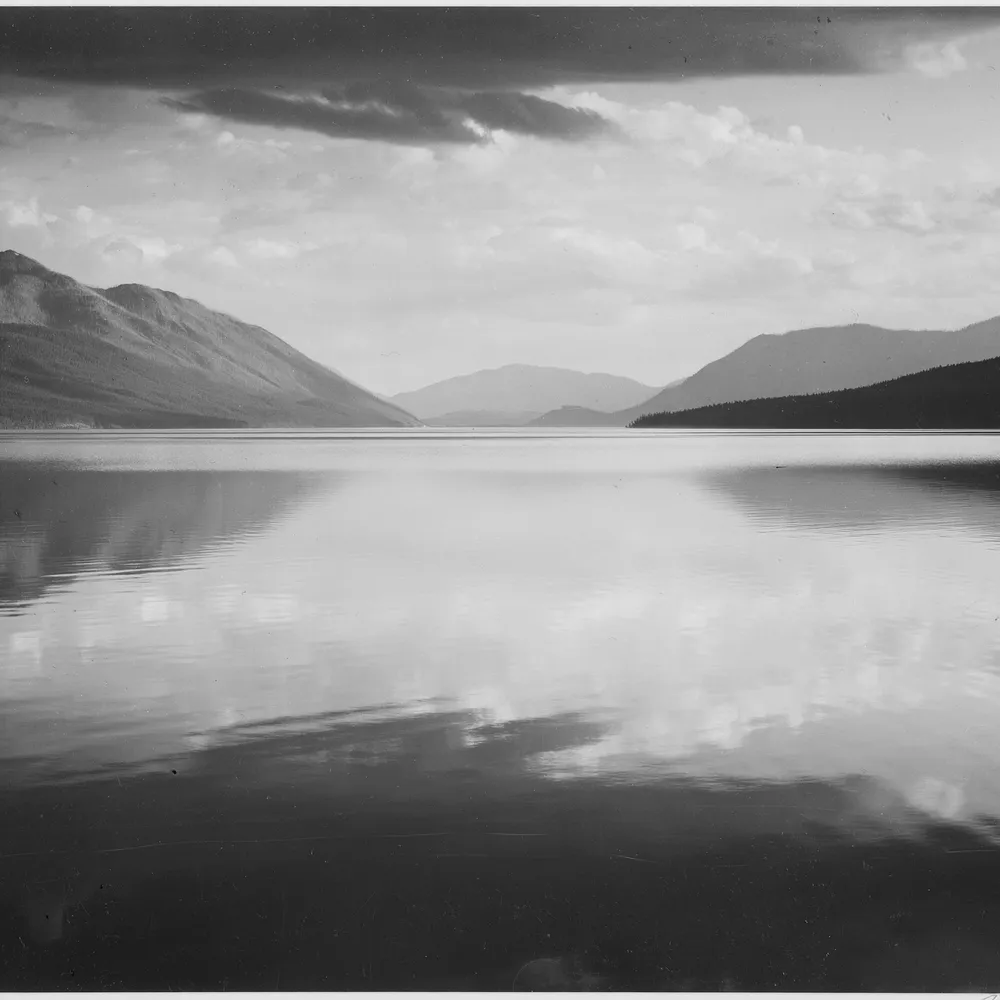
Take a lake on HP5 Plus, sun over your left shoulder. The far hillside and the sky above it sit in the 90-degree band. Rotate the filter until the sky in the finder goes deepest, then meter through it: a polarizer loses a fixed amount regardless of scene, around 1.5 stops for a B+W or Hoya circular (filter factor near 2.5 to 4), less for a high-transmission Hoya HRT. The base loss comes from blocking one plane of unpolarized light and does not change as you rotate; only the smaller, scene-dependent removal of already-polarized light varies with orientation, so meter after you have set the angle, not before. If the darkened sky meters at Zone V, an exposure that places it on Zone III drops it two stops, holding clouds as clear highlights against it. Then tilt the camera down toward the water at roughly 53 degrees off the normal and re-rotate: surface glare collapses and submerged rocks appear, at the price of re-metering for the new orientation.
For a near-black sky, do not ask the polarizer to do everything. Ansel Adams, in The Negative (1981), darkened skies with deep Wratten filtration, the 25 red or 29, and finished the tone by printing-down in the darkroom rather than leaning on the polarizer alone. The filter gives you 70 to 80 per cent of a band of sky, not a black one. The last stretch is exposure, development and the print.
Image: Ansel Adams, “Evening, McDonald Lake, Glacier National Park,” Montana, 1933–1942. National Archives (NARA 519861). Public domain.
· 6 min read
Why the blue filter exaggerates atmospheric haze and softens distance in black-and-white, and how it recreates the rendering of early orthochromatic emulsions.
· 6 min read
How weighting red, green and blue channels in conversion reproduces the effect of physical filters, and where sensor color response sets the limits.
· 6 min read
How filter factors are derived, why they shift with light source and film, and how to convert a factor into stops of added exposure.
The grainmag companion app
Meter and place your tones without a signal. No account, no internet required — just you, the light, and the grain.